





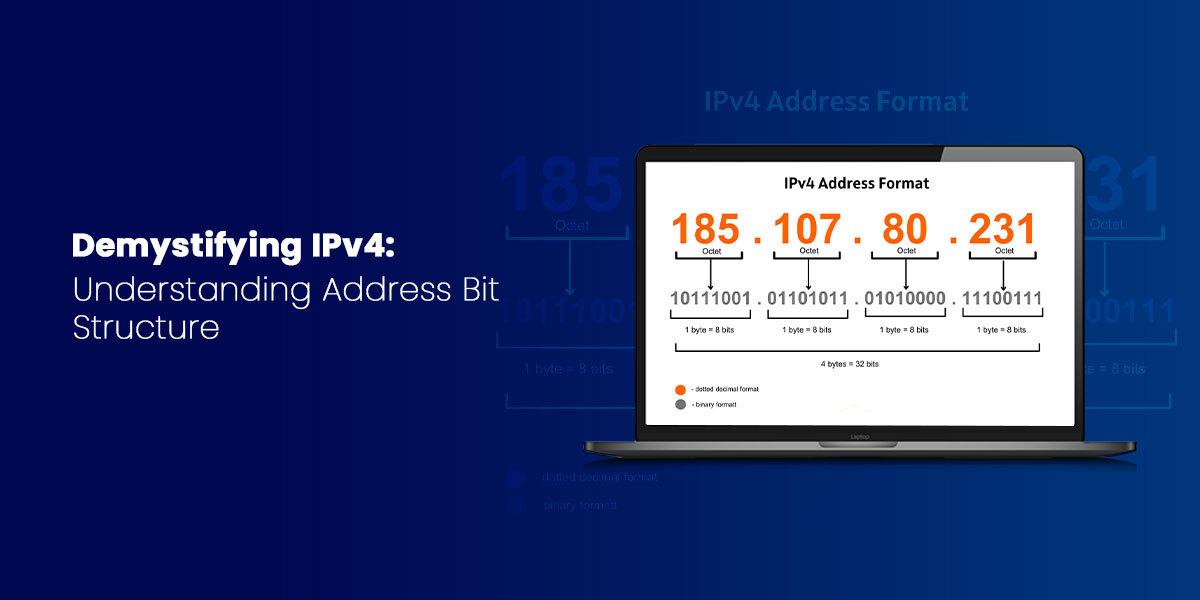
The world of networking relies on a standardized addressing system to ensure the seamless communication of devices across the vast landscape of the internet. In this digital realm, Internet Protocol version 4 (IPv4) addresses play a pivotal role in identifying and routing data between devices. To comprehend the intricacies of IPv4 addresses, it's essential to delve into their fundamental structure and understand the significance of the number of bits involved.
Understanding IPv4 Address Structure
IPv4 addresses, despite their ubiquity, encapsulate a complexity that goes beyond their dotted-decimal representation. At their core, these addresses are 32-bit numerical labels that serve as unique identifiers for devices on a network. This 32-bit structure is not arbitrary; it is a carefully calculated compromise that balances the need for a large address space with the practicalities of implementation.
Each IPv4 address is divided into four octets, with each octet consisting of 8 bits. The 8 bits in each octet allow for 2^8, or 256, possible combinations, ranging from 0 to 255. This modular arrangement not only aligns with historical computing standards but also provides a flexible and intuitive way to express these addresses.
The Significance of 32 Bits
The 32 bits in an IPv4 address hold immense significance in determining the address space available within this protocol. With a total of 2^32 possible combinations, IPv4 theoretically allows for approximately 4.3 billion unique addresses. This large address space was initially thought to be more than sufficient. However, as the internet proliferated, the limitations of IPv4 became evident, leading to the development and adoption of IPv6 with its vastly expanded address space.
The concept of bits is fundamental to the binary nature of computing. A bit, the smallest unit of digital information, can exist in one of two states: 0 or 1. In the context of IPv4, the 32 bits create an address space where each bit is a binary decision, contributing to the unique identification of devices on the network.
The Evolution of IP Addresses
IPv4's journey from inception to widespread adoption reflects the dynamic nature of technological evolution. When the internet was in its infancy, the concept of 4.3 billion unique addresses seemed extravagant. However, as the digital landscape expanded, this number proved insufficient.
This limitation led to the development and implementation of IPv6. Unlike its predecessor, IPv6 operates on a 128-bit address space, offering a staggering 2^128 unique addresses. This expansion ensures that, for the foreseeable future, the internet can accommodate the ever-growing multitude of devices connecting to it.
IPv6 also brings efficiency improvements over IPv4. Its simplified header structure enhances routing and reduces the burden on networking equipment. Additionally, IPv6 incorporates features like stateless address autoconfiguration, making it easier for devices to connect and communicate seamlessly.
The Challenge of IPv4 Exhaustion
IPv4 exhaustion became a looming challenge as more devices sought connectivity. Regional Internet Registries (RIRs) responsible for allocating IP addresses found themselves grappling with the inevitable depletion of available IPv4 addresses. This scarcity spurred a global effort to transition to IPv6, a process that, while ongoing, faces hurdles in widespread implementation.
The Role of NAT (Network Address Translation)
To cope with IPv4 limitations, Network Address Translation (NAT) emerged as a temporary solution. NAT allows multiple devices within a private network to share a single public IPv4 address. While this alleviates the immediate shortage, it introduces complexities and potential limitations, especially for certain applications and services that rely on unique public IP addresses.
Conclusion
In the realm of networking, understanding the fundamentals of IPv4 addresses is crucial. The 32 bits in an IPv4 address dictate its structure, providing a balance between practicality and scalability. As we continue to witness the exponential growth of the digital landscape, the transition to IPv6 showcases the necessity for an even more expansive address space.
The journey from IPv4 to IPv6 reflects the dynamic nature of technology and the continual evolution required to sustain the ever-expanding connectivity of the modern world. While IPv4 addresses will persist for the foreseeable future, the global shift towards IPv6 signals a proactive response to the challenges posed by the relentless growth of the internet and the increasing number of connected devices.
FAQs
1. Why are there 32 bits in an IPv4 address?
The choice of 32 bits in IPv4 addresses is rooted in a balance between practicality and scalability. With 32 bits, IPv4 provides a substantial address space, allowing for billions of unique addresses. At the time of its development, this was deemed sufficient, but the exponential growth of the internet necessitated the evolution to IPv6, which boasts a much larger address space.
2. How is the 32-bit IPv4 address divided into octets?
The 32-bit IPv4 address is divided into four octets, with each octet comprising 8 bits. The division facilitates easier human readability and simplifies the expression of the address. For example, the address 11000000.10101000.00000000.00000001 is more intuitively presented as 192.168.0.1.
3. What is the significance of the 8 bits in each octet?
The 8 bits in each octet allow for 2^8, or 256, possible combinations ranging from 0 to 255. This flexibility enables a diverse range of addresses within each octet. It also aligns with the historical development of computing systems, where 8-bit bytes were a common standard.
4. Why is IPv4 limited to approximately 4.3 billion addresses?
The 32-bit structure of IPv4 provides 2^32, or around 4.3 billion, unique addresses. While this seemed abundant initially, the explosive growth of the internet and the increasing number of connected devices quickly exhausted this address space. IPv6 was introduced to address this limitation by offering an astronomically larger pool of unique addresses.
5. Are all 4.3 billion IPv4 addresses available for use?
No, not all 4.3 billion IPv4 addresses are available for general use. Some addresses are reserved for special purposes, such as private networks, multicast groups, and loopback testing. Additionally, certain blocks of addresses are designated for specific regions or organizations to manage and allocate as needed.
6. How does IPv4 compare to IPv6 in terms of address space?
IPv6, the successor to IPv4, operates on a 128-bit address space. This vast expansion provides an unimaginable number of unique addresses, effectively eliminating the concerns of address exhaustion that prompted the transition from IPv4. IPv6's address space is so extensive that it can accommodate virtually limitless devices, ensuring the continued growth of the internet.